










Assam Assembly Enacts Heritage Land Bill Amid Political Discourse
In a significant legislative move, the assam assembly approved a new bill aimed at safeguarding land surrounding various culturally and religiously significant
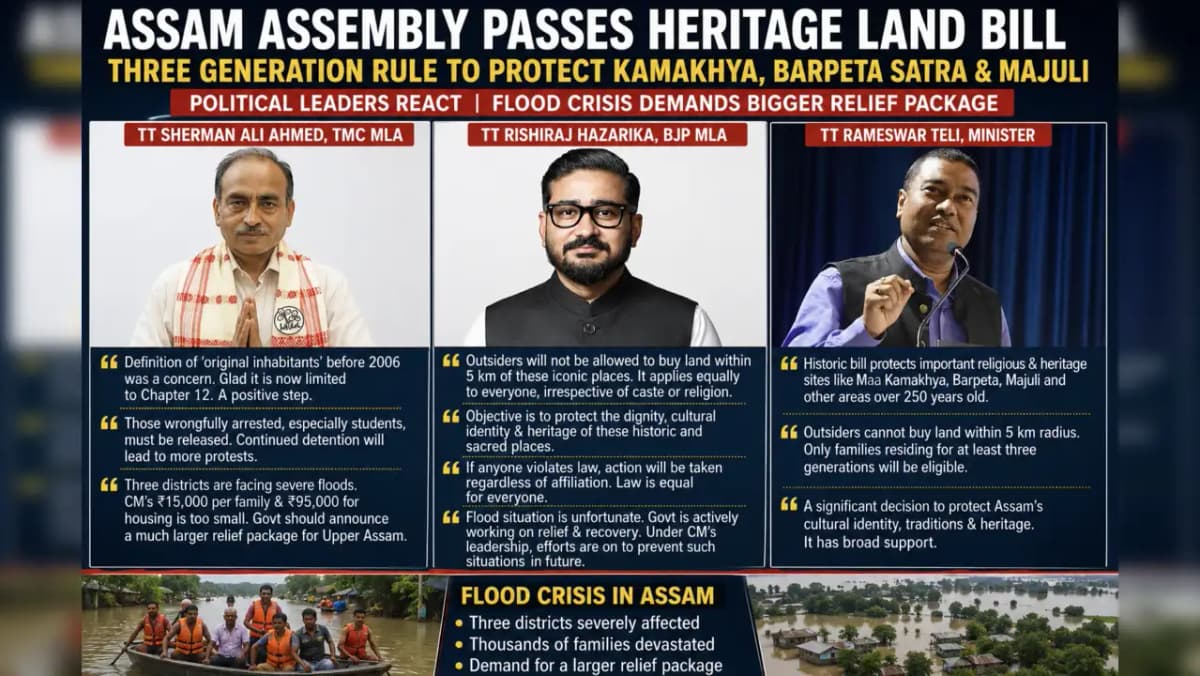
In a significant legislative move, the Assam Assembly approved a new bill aimed at safeguarding land surrounding various culturally and religiously significant sites, such as Kamakhya, Barpeta Satra, and Majuli. This legislation introduces specific restrictions on land acquisitions by individuals from outside the designated areas, a decision that has sparked a variety of reactions among political leaders. Members from both the ruling Bharatiya Janata Party (BJP) and the opposition Trinamool Congress (TMC) expressed support for the bill, albeit with differing perspectives on its implications and provisions. TMC MLA Sherman Ali Ahmed expressed his approval of the amendment concerning the definition of original inhabitants, noting that the criteria for defining these individuals based on their residency in the state prior to 2006 had raised some concerns. However, he viewed the limitation of this definition to Chapter 12 as a positive adjustment. On the other hand, BJP MLA Rameswar Teli hailed the legislation as a historic step towards preserving Assam's rich cultural and traditional heritage. He emphasized that the bill encompasses vital religious and heritage sites, including the revered Maa Kamakhya, Barpeta, and Majuli, all of which boast a history of over 250 years. Teli clarified that individuals from outside the designated areas would be prohibited from purchasing land within a five-kilometer radius of these protected sites, while families that have resided in these areas for a minimum of three generations would be eligible to acquire land under the new provisions.
BJP MLA Rishiraj Hazarika also defended the newly passed legislation, asserting that the restrictions were not intended to target any specific caste or religion. He articulated that the primary goal was to uphold the dignity, cultural identity, and heritage of these iconic locations, which he claimed have experienced a gradual decline in their traditional character over the years. During the discussions, the leaders addressed inquiries regarding the ongoing protests by Citizens for Justice and Peace (CJP) and the prevailing flood situation in Assam. Hazarika mentioned that he had only been informed about the developments through media coverage and had not personally witnessed the protests at Jantar Mantar. He reiterated that the law should be applied uniformly to all individuals, regardless of their political or organizational affiliations. In contrast, Sherman Ali Ahmed called for the release of individuals who had been wrongfully detained, particularly those involved in the protests, emphasizing that any existing orders for their release should be honored. He cautioned that the continued detention of students could incite further protests and urged that the reasons behind the demonstrations be taken into account.